

A privacy fence has to do more than block a neighbor’s view. In Seattle-area yards, the best privacy fence styles also need to stand up to long wet seasons, occasional windstorms, sloped lots, and the visual demands of closely spaced homes. The right choice creates a more usable backyard without becoming a maintenance problem or an awkward wall along the property line.
For most homeowners, the decision comes down to the balance between privacy, appearance, maintenance, budget, and how the fence will handle Pacific Northwest weather. A design that looks excellent in a dry climate may not be the most practical choice for a shaded, moisture-prone yard in King or Snohomish County.
Best Privacy Fence Styles for Northwest Properties
Full-Panel Vertical Cedar Fencing
A full-panel vertical cedar fence remains one of the most dependable choices for residential privacy. Boards run vertically with little or no gap between them, creating a clean barrier around a backyard, side yard, pool area, or hot tub space. This is the traditional privacy-fence look, but it can be built with several top details, including flat caps, lattice accents, stepped sections, or a gently arched profile.
Cedar is especially well suited to the Pacific Northwest. It has natural resistance to decay and insects, and it handles seasonal moisture better than many lower-cost wood options when it is properly installed. A well-built cedar fence should include sound posts, adequate ground clearance, appropriate fasteners, and framing designed to prevent sagging over time.
This style is a practical fit when your top priority is complete visual screening. It also works well where properties sit close together or where a fence needs to separate an entertaining area from a neighboring driveway or window. The trade-off is that a solid fence catches more wind than an open design, so post depth, post spacing, and framing details matter.
Horizontal Cedar Privacy Fences
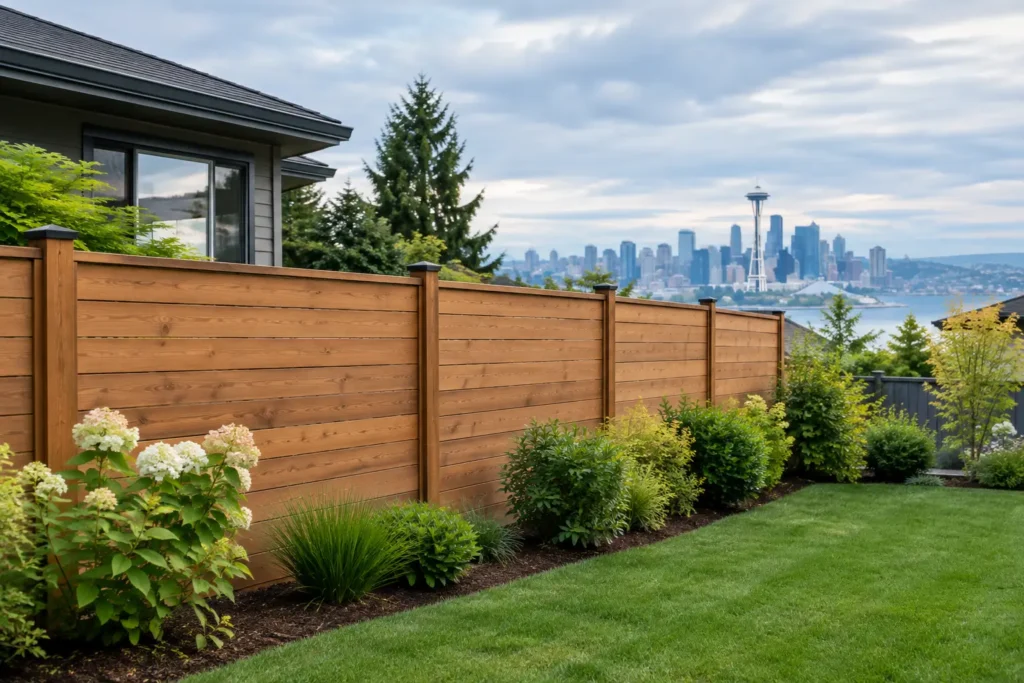
Horizontal fencing gives a property a more contemporary, tailored appearance. The boards run side to side rather than up and down, often with narrow, consistent gaps or a fully closed layout. It is a popular option for modern homes, remodeled mid-century properties, and outdoor spaces with new decks, pergolas, or clean-lined landscaping.
The appeal is clear: horizontal lines can make a compact yard feel wider and more intentional. But this is not a place to cut corners. Long horizontal boards require careful material selection, stable framing, and exact spacing. Lower-grade lumber can cup, twist, or show uneven gaps as it weathers, particularly where a fence receives strong sun on one side and constant moisture on the other.
A horizontal cedar fence generally costs more than a basic vertical fence because it requires more precise installation and often more framing. For homeowners who value architectural detail and want the fence to complement a custom deck or covered outdoor area, the added investment can be worthwhile.
Board-on-Board Fencing
Board-on-board fencing uses overlapping vertical boards rather than a single row of tightly placed boards. From either side, the fence appears solid, yet the overlapping layout allows small spaces for air movement. This construction can help the fence accommodate normal wood expansion and contraction without developing obvious sightlines.
It is an excellent option for privacy between neighboring yards because both sides have a finished appearance. Unlike a standard good-neighbor fence, where one side may show rails, board-on-board construction looks intentional from each property. It is also more forgiving on lots that get regular wind exposure.
The drawback is material use. Overlapping boards require more lumber than a standard solid-panel fence, so the price can be higher. Still, it offers a strong combination of privacy, durability, and curb appeal for homeowners planning to stay in their home for years.
Louvered Privacy Screens
Louvered fence panels use angled boards that limit direct views while allowing light and air to move through. They can be built as a full perimeter fence, but they are often most effective as a feature section near a patio, deck, outdoor kitchen, hot tub, or seating area.
This style brings a finished architectural quality to an outdoor living space. It can screen a neighbor’s second-story view without making the entire yard feel closed in. Depending on the angle and spacing, louvers can provide meaningful privacy while reducing wind pressure compared with a fully solid wall.
Because of the added layout work and the need for precise, consistent angles, louvered construction is more specialized than a basic privacy fence. It is best used where the design value and targeted screening justify the additional labor.
Privacy Fences With Decorative Top Sections
A solid lower fence with an open lattice, framed grid, or narrow horizontal top section is a useful middle ground. The solid portion protects everyday privacy at eye level, while the open upper section brings in light and softens the height of the fence.
This approach works well in smaller backyards where a full six-foot solid wall may feel heavy. It is also a good way to preserve a little openness near garden beds or mature trees. For a yard with a view worth keeping, a lower solid screen paired with a more open upper detail may deliver privacy without shutting out the landscape.
Keep in mind that decorative openings do reduce complete screening. If a neighbor’s deck or windows look down into your yard, a lattice top may not solve the problem on its own. An onsite assessment helps determine the correct height and placement before construction begins.
Material and Construction Matter as Much as Style
A fence style is only as durable as the materials and installation behind it. In the Seattle area, moisture is the long-term test. Posts need a stable foundation, wood needs clearance from soil and standing water, and rails need to be positioned to support the boards without creating unnecessary water traps.
Cedar is a common premium choice because it is attractive, stable, and naturally suited to wet conditions. Pressure-treated lumber is often used for structural components where appropriate. Composite and vinyl privacy fencing can reduce routine upkeep, but each has limitations. Vinyl can feel less natural and may become brittle over time, while composite products vary widely in quality, expansion characteristics, and cost.
For many homes, a cedar fence with quality hardware and a practical finish plan offers the best long-term value. It looks appropriate in Northwest landscapes, can be customized to the property, and can be repaired in sections if damage occurs.
Height, Setbacks, and Neighbor Considerations
Privacy needs often lead homeowners straight to fence height, but local rules should be checked before the design is finalized. Height limits, corner-lot visibility requirements, utility easements, homeowner association standards, and property-line questions can all affect the project. A six-foot fence is common for rear and side yards, but a taller screen is not automatically allowed or necessary.
It is also wise to confirm the property line before removing an old fence or setting new posts. Existing fences are not always installed on the actual boundary. If a shared fence is involved, a straightforward conversation with the neighbor before work begins can prevent confusion later, especially if access from both yards is needed during installation.
On sloped sites, the fence layout deserves extra attention. A stepped fence follows level sections down the grade, while a racked fence follows the slope more closely. Stepped construction can leave small gaps near the ground, whereas racking requires boards and rails that can accommodate the angle. The best approach depends on the grade, desired appearance, and whether pets or children need a fully enclosed yard.
Choosing a Fence That Fits the Way You Use the Yard
Start with the problem you need the fence to solve. For total backyard screening, a solid vertical cedar or board-on-board fence is usually the most direct answer. For a new deck, pergola, or patio where appearance matters as much as privacy, horizontal cedar or targeted louvered screens may better suit the space.
Also consider maintenance realistically. Wood fencing benefits from periodic cleaning and may need staining or sealing depending on the look you want and the exposure it receives. Shaded areas should be kept clear of vegetation and soil buildup so moisture does not remain against the boards. Choosing a durable design from the beginning is less expensive than repeatedly patching a fence that was underbuilt for the site.
The best privacy fence is not simply the tallest or most expensive option. It is the one that fits your property lines, holds up through wet seasons, complements the home, and gives you a backyard you will actually use. For a clear, fixed-scope recommendation based on your yard, call Kevin at (425) 449-6739 to schedule an onsite estimate with Seattle Fence and Decks.
For tailored advice regarding the best privacy fence styles, reach out to local experts in the field. In conclusion, being knowledgeable about the best privacy fence styles can greatly enhance your home’s value and functionality. Understanding the different best privacy fence styles available will empower homeowners in their fence selection process. Investing in the best privacy fence styles fosters a more enjoyable and secure outdoor experience. Ultimately, selecting from the best privacy fence styles should align with both personal preference and practical needs. Each of the best privacy fence styles serves a specific purpose, tailored to diverse homeowner needs.
When evaluating your options, consider how the best privacy fence styles can fit into your overall landscape design. Many homeowners find that the best privacy fence styles also offer valuable property protection. Privacy needs may lead you to explore the best privacy fence styles that align with your lifestyle. Consider the aesthetic qualities of the best privacy fence styles when planning your outdoor space.
Exploring the best privacy fence styles can help you select the right design for your yard’s layout. Board-on-board fencing is among the most durable of the best privacy fence styles available. For those exploring the best privacy fence styles, horizontal cedar options provide a modern flair. Among the best privacy fence styles, the full-panel vertical cedar fencing is a popular choice for its sturdiness. Choosing from the best privacy fence styles can also enhance the overall curb appeal of your home. Many homeowners in Seattle consider the best privacy fence styles to ensure they have a serene outdoor experience.
Researching the best privacy fence styles can inform your decision-making process and lead to a better investment for your property. Different types of the best privacy fence styles might be needed depending on your immediate environment and neighbors. Understanding the best privacy fence styles available can greatly enhance your outdoor space, ensuring both function and aesthetics. When considering the best privacy fence styles, homeowners should take into account the unique challenges of Seattle’s weather and landscape.